Charminar: Why was Hyderabad’s Iconic Monument Built

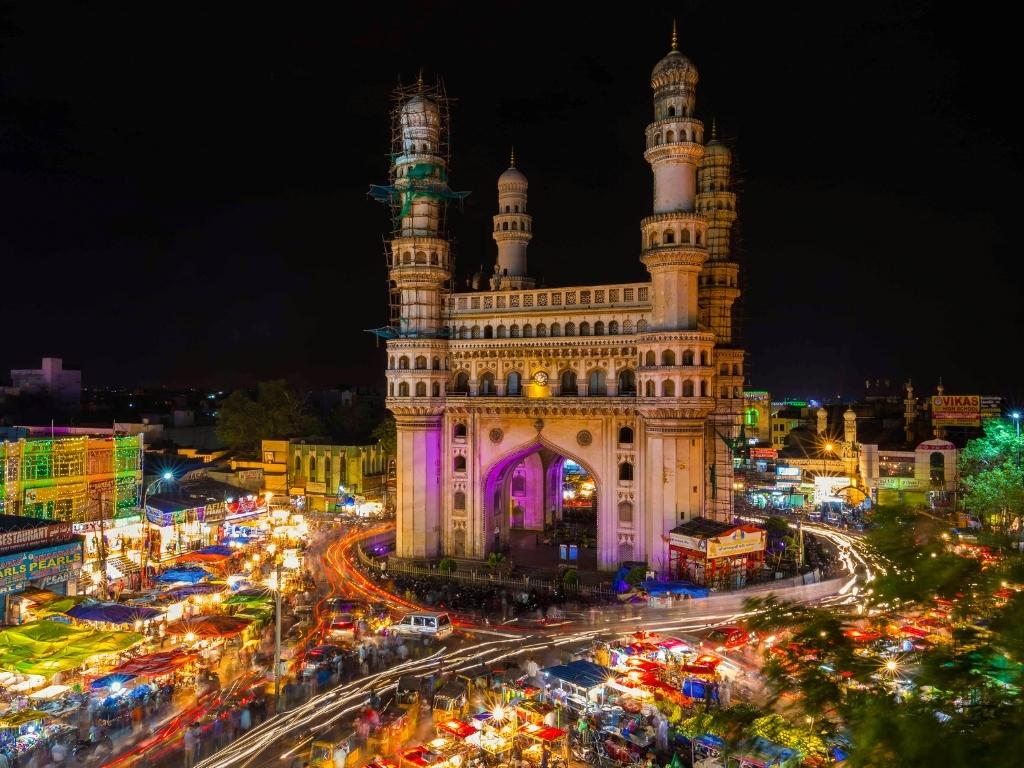
When you think of Hyderabad, one landmark instantly comes to mind: Charminar. But beyond its four towering minarets lies a story of history, culture, spirituality, and living tradition that continues to shape the heart of the city.
Why Was Charminar Built?
Charminar was built in 1591 by Sultan Muhammad Quli Qutb Shah, the fifth ruler of the Qutb Shahi dynasty.
1. Marking Hyderabad’s Birth
Charminar signified the shift of the capital from Golconda to Hyderabad. It was constructed at the very center of the new city. Streets and marketplaces were designed to radiate outward from this point, making Charminar the epicenter of urban planning. Persian architects were invited, reflecting the Sultan’s grand vision for a culturally rich and globally connected city.
2. Commemoration of the Plague’s End
A widely accepted theory claims Charminar was built to celebrate the end of a deadly plague. The Sultan is believed to have prayed for its end and vowed to build a monument in gratitude. Once the plague subsided, Charminar was erected as a spiritual offering and symbol of hope.
3. Religious and Spiritual Intent
Charminar housed a mosque and madrasa, anchoring the city spiritually and intellectually. The structure’s four minarets are said to represent the first four caliphs of Islam. Some historians also link its design to Shia Tazias (structures used in mourning processions), tying it to the remembrance of Imam Hussain, further reinforcing its spiritual undertones.
4. To Mark the Second Islamic Millennium
Another credible theory states that Charminar marked the beginning of the second Islamic millennium (1000 AH). This milestone held immense importance in the Islamic world. Building a monumental gateway in its honor gave Hyderabad immediate religious and cultural relevance.
5. A Story of Love
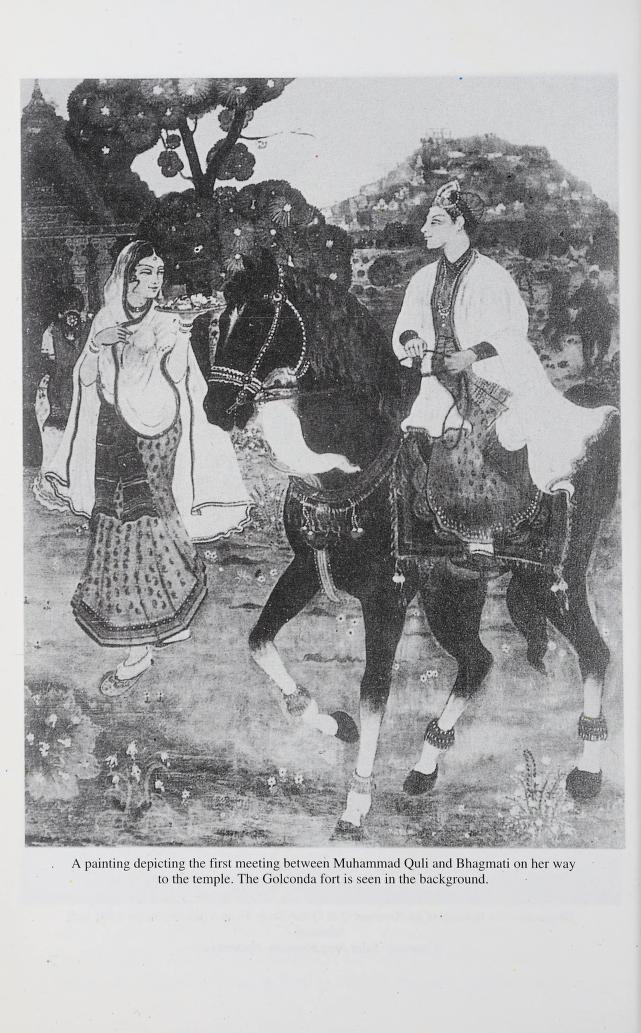
A romantic, but historically unsupported, narrative says Charminar was built where the Sultan first met his future queen, Bhagmati. While this tale captures imaginations, there’s no solid evidence linking the monument to this love story.
This brings us to the question…
Did Bhagmati Even Exist?
A widely told tale claims that Prince Muhammad Quli Qutb Shah fell in love with a Hindu maiden named Bhagmati from the village of Chichlam. Legend says he crossed the dangerous Musi River often just to meet her. To ensure his son’s safety, Sultan Ibrahim Qutb Shah is believed to have built the Purana Pul bridge in 1578.
Chronological Inconsistencies
While charming, this tale raises historical concerns, and the timeline doesn’t fit. Purana Pul was built in 1578. Muhammad Quli was born in 1566. That would make him around 12 years old when the bridge was completed, far too young for the kind of love story described.
The bridge’s physical presence alone challenges the credibility of the romantic narrative and often lends undue credibility to the story. Yet, many scholars argue that this connection between the bridge and romance is more folklore than fact.
Absence in Contemporary Deccani Sources
Bhagmati’s name appears nowhere in official court chronicles from the Qutb Shahi period. Notable works like Tarikh-i-Sultan Muhammad Qutb Shah, Hadiqat ul-Salatin, and Hadaiqus Salatin omit her entirely.
The Sultan’s own poetry collection, Kulliyat, names 17 mistresses, but not Bhagmati. He always refers to the city as ‘Shahre Hyderabad’, never ‘Bhagnagar’. Deccani historian Ali Bin Aziz Taba Taba also fails to mention her.
Upon ascending the throne in 1580 at the age of 15, the Sultan is believed to have founded a new city, approximately 6 kilometers from Golconda, across the Musi River, near Bhagmati’s alleged birthplace. This new city was initially named Bhaganagar or Bhāgyanagar in her honor.
No Tangible Archaeological Evidence
Unlike other prominent courtesans, such as Taramati and Premamati, whose graves are clearly identifiable within the royal necropolis at Golconda, there is no confirmed tomb or grave of Bhagmati. Alleged tombs, such as one in Talab Katta, have no inscriptions and don’t date back to the 16th century.
Did you know Charminar is featured on old currency notes and has a train named after it: the Charminar Express?
However, no coins, inscriptions, or contemporary art mention her. Even Hyderabad’s earliest coins (1603) bear the name ‘Dar-ul-Sultanate Hyderabad’, and not Bhagnagar. The supposed village of Chichlam remains unverified by archaeologists.
Problems with the ‘Hyder Mahal’ Theory
Over time, a narrative claimed that Quli Qutb Shah built a new city near her village, naming it Bhagnagar in her honor. Once Bhagmati converted to Islam and was renamed Hyder Mahal, the city’s name changed to Hyderabad. But historians like Dr. Mohd. Safiullah challenge this theory.
He argues that ‘Hyder’ is a sacred title linked to Hazrat Ali, the first Shia Imam. He notes that this title has never historically been given to a woman. Instead, it’s more likely the city was named in honor of Hazrat Ali.
Influence of Later Accounts
Many accounts of Bhagmati came decades after her supposed death, often from outsiders unfamiliar with court life. Historian Ferishta, for example, never visited Hyderabad.
Perhaps most revealing is the confession of Dr. Mohiuddin Quadri Zore, a prominent 20th-century historian. He admitted to inventing and romanticizing Bhagmati’s story to give Muhammad Quli a romantic legacy, akin to Shah Jahan and the Taj Mahal.
In his own words:
I brought in Bhagmati, though she never existed, so that people would remember the ruler.
Not Fiction but Possible Erasure
Some suggest Bhagmati’s absence may be due to deliberate omission. Scholar Ziauddin Ahmed Shakeb speculates that Prime Minister Mir Momin, a devout and influential figure, may have suppressed all references to her, disapproving of her closeness to the Sultan. This theory hints at political censorship, not nonexistence, but remains speculative and lacks hard proof.
In & Around Charminar
Step closer to Charminar and every detail will tell you a story.
- Arches facing all four directions (20 meters high)
- 149 spiral steps leading to the top floors
- An ancient mosque on the upper level, still in use today
- Delicate carvings, Islamic calligraphy, and floral Hindu-inspired motifs
Crafted with granite, limestone, and lime mortar, Charminar is built with natural ventilation shafts and water systems built into its structure.
The area around Charminar is buzzing with life and tradition.
- Laad Bazaar: Glittering bangles, Hyderabadi pearls, custom jewelry.
- Pathar Gatti: High-quality silver and rare natural pearls.
- Shehran Market: Sarees, suits, textiles, and custom tailoring.
- Mecca Masjid Lane: Islamic artifacts and religious items.
The aroma of attar perfumes, the sound of the call to prayer, and the colorful chaos of shops and food stalls are an authentic part of Hyderabad’s soul.
After Thoughts
Charminar faces threats from pollution, traffic, poor maintenance, and illegal structures. Thankfully, efforts like the Charminar Pedestrianization Project aim to protect this treasure. Charminar is a place where spirituality, commerce, architecture, and community intersect. Whether you’re walking under its arches or shopping in its shadow, you’re stepping into a story over 430 years old.